
- This event has passed.
Figures of Authority: Argumentative Strategies, Exemplary Motifs, and Narrative Patterns in the Political Advice Literature of the Premodern Islamic World
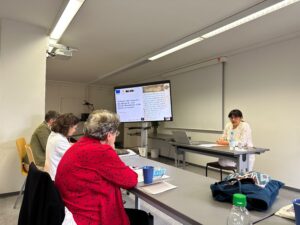
From 15 to 16 June 2026, the University of Tübingen hosted the international workshop Figures of Authority: Argumentative Strategies, Exemplary Motifs, and Narrative Patterns in the Political Advice Literature of the Premodern Islamic World. Organized by Marianna Zarantonello at the Department of Oriental and Islamic Studies, the workshop was held within the framework of her research project Mirrors of the Past. The Modulation of Historical Narratives in Early Arabic Political Advice Literature, which investigates the use of historical narratives and exemplary figures as argumentative strategies in political advice literature.
The workshop brought together scholars working on Arabic, Persian, and Turkish traditions to examine the different narrative, rhetorical, and exemplary strategies through which political authority and counsel were articulated in the premodern Islamic world.
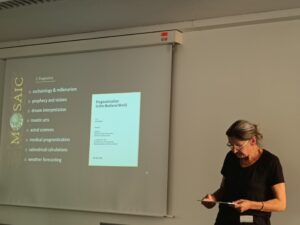
Two members of the MOSAIC project participated in the workshop with individual papers. Laura Tribuzio and Petra G. Schmidl approached political advice from two different textual and historical contexts, looking at the ways in which counsel could be expressed beyond the most conventional forms of the mirror-for-princes tradition.
Laura first reconstructed the largely overlooked and still understudied Persian tradition of the Epistle of the Animals, tracing its development from the Ilkhanid to the Qajar period and considering how the narrative was adapted to different intellectual, religious, and political contexts. She then focused on the Persian Būstān al-ʿuqūl, a substantial reworking of the Epistle of the Animals of the Ikhwān al-Ṣafāʾ produced in the Ilkhanid period. She examined the work as an indirect or allegorical mirror for princes, in which the original debate between humans and animals is reframed within a markedly courtly setting. Through animal speech, exemplary figures, envoys, sages, and rulers, the text develops a reflection on justice, legitimate authority, counsel, and the qualities expected of those who govern. The preface further situates the work within the political and intellectual world of Ghazan Khan and his court.
Petra’s paper, Prognostics as Advice at Court: Examples from Rasūlid Yemen, turned to the scholarly activities of the Rasūlid sultans of thirteenth- to fifteenth-century Yemen. Prognostics are not a genre of advice literature in themselves, but astrology, arithmancy, and related techniques could provide rulers with forms of knowledge useful for anticipating events and supporting decisions. The Rasūlid case is particularly interesting because several sultans were themselves scholarly authors. Petra therefore asked whether texts produced by these rulers, or closely associated with their court, could also function as a form of advice directed to the ruler himself.
Both papers thus highlighted the flexibility of political advice and the different forms that knowledge could assume when brought into a courtly context.