
- This event has passed.
Fifteenth Biennial Iranian Studies Conference
From 5 to 8 August 2026, Utrecht University hosted the Fifteenth Biennial Iranian Studies Conference, organized by the Association for Iranian Studies (AIS) in collaboration with Utrecht University.
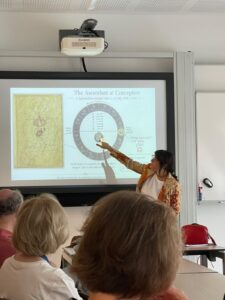
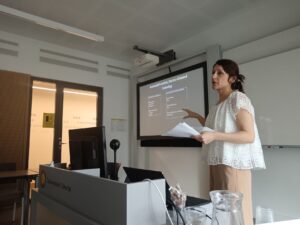
On 7 August, Laura Tribuzio chaired the panel Embodied Cosmologies: Devotion, Knowledge, and Esoteric Traditions in the Premodern Islamicate World. In its final form, the session brought together two closely related papers by Laura Tribuzio and Dominique Sirgy, both examining how Persian encyclopaedic traditions reworked inherited systems of knowledge to make cosmological principles operative in the material and human world.
Laura Tribuzio focused on the anonymous thirteenth-century Persian Mujmal al-ḥikma, examining its substantial reworking of the cosmology of the Ikhwān al-Ṣafāʾ. Beginning with generation itself, the Mujmal brings together alchemy, embryology, and astrology: mineral generation is explained through mercury and sulphur, while human generation unfolds under the successive governance of the seven planets. Celestial configurations do not merely accompany embryonic development but shape bodily and psychological dispositions. The text ultimately extends this logic from the formation of the individual body to political and prophetic authority, connecting particular planetary combinations and conjunctions with the emergence of kings and prophets.
Dominique Sirgy turned to Ḥusayn ʿAqīlī Rustamdārī’s Riyāż al-abrār, a major Persian encyclopaedia composed in Qazvin in 1571 for the Safavid ruler Shah Ṭahmāsp I. Organising ninety sciences, Rustamdārī reworks earlier models of classification, notably that of Fakhr al-Dīn al-Rāzī’s Jāmiʿ al-ʿulūm, while including a significant number of occult sciences omitted by his predecessor. Sirgy showed how this reorganization reflects a cosmology understood through its practical effects: alchemy gives material form to cosmic powers, including those encoded in letters, while astrology translates celestial configurations and movements into knowledge about events in the human world.
The point of convergence between the two papers lay precisely here. Despite the very different contexts of the thirteenth-century Mujmal and Rustamdārī’s sixteenth-century Safavid encyclopaedia, both texts transform inherited cosmological knowledge by asking what cosmic forces do. In the Mujmal, they enter matter, govern the formation of the embryo, and contribute to the production of human, royal, and prophetic qualities; in the Riyāż al-abrār, they become accessible through sciences capable of reading, manipulating, or materializing their effects.
The two contributions thus approached embodied cosmology as a dynamic relationship between cosmos and terrestrial life: celestial and spiritual powers take concrete form in matter, bodies, practices of knowledge, and structures of authority.